
As I touched on in a previous blog post, changing up my art media recently made me understand a bit more what people have often told me, "watercolor is the hardest medium". It's difficult to see something as hard if you do not have a comparison.
I used to do pastels, acrylic and lots of other creative things - sewed clothing, crocheted, knitted etc. but it's been awhile since I really used another visual media seriously, like maybe twenty years. I used to think that getting up in front of people to speak, teach, sing and act was a lot harder than watercolor painting - in the trepidation factor anyway! Fear tends to fade the more you face it.
A mentor of mine, Phyllis Higgins, once explained that hundreds of decisions are made hourly when you mix pigments together. It's tiring and all-consuming, to concentrate on a section of paper for hours at a time. Watercolor painting adds the element of transparency and requires you to think constantly, "how much?" "when?" "where?" "should I wait?"... this causes some degree of mental exhaustion.
Watercolor painting has been with me since I was eleven, so creating work with this medium has become very natural - sort of like coloring with crayons. Most things worked at diligently do go from conscious to subconscious at some point of mastery. I have not yet mastered the art of Japanese Sumi-e, but below are a few more pieces, a start to something larger.
Painting with black ink also requires thought, but less to the degree that you are only diluting black ink to make different shades of gray. These were really fun to paint. "I like it loose!" as my old painting friend, Frank Sheard, used to say!
Very clearly shines a memory: A large ink painting of a rural Chinese landscape that was approximately two by four feet, hung on the wall of the Taipei Airport as my sister and I passed by on our way home from our month in Taiwan. It was beautiful, striking in it's detail and simplicity. Black, gray tones and white made up the mountains and small shack, that's all I remember of the scene - but no other color.
In April, the Japan Society of NYC held a fundraiser for victims of the Fukushima earthquake and nuclear disaster. I attended and learned a few new things. One was taking a short class in Japanese Shodo - calligraphy. Again, black ink is used with a brush to "speak". This short calligraphy workshop really helped me want to return to ink painting.
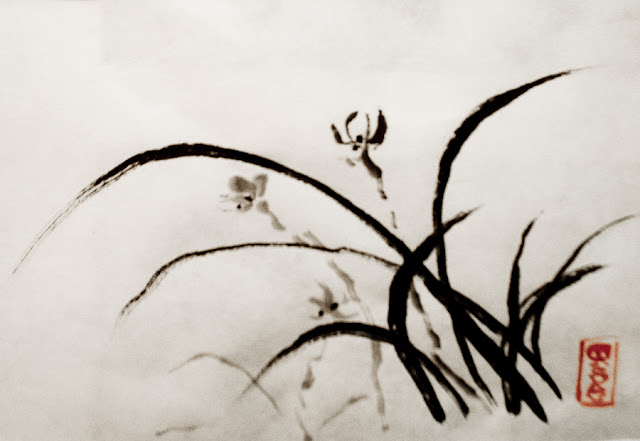
Below, a wild orchid "speaks" a message of it's delicate, gentle beauty. Again, my photography isn't great, sorry, the peonies are both really blurry. Please forgive that part of this post!
Wild Orchid
I used to do pastels, acrylic and lots of other creative things - sewed clothing, crocheted, knitted etc. but it's been awhile since I really used another visual media seriously, like maybe twenty years. I used to think that getting up in front of people to speak, teach, sing and act was a lot harder than watercolor painting - in the trepidation factor anyway! Fear tends to fade the more you face it.
A mentor of mine, Phyllis Higgins, once explained that hundreds of decisions are made hourly when you mix pigments together. It's tiring and all-consuming, to concentrate on a section of paper for hours at a time. Watercolor painting adds the element of transparency and requires you to think constantly, "how much?" "when?" "where?" "should I wait?"... this causes some degree of mental exhaustion.
Watercolor painting has been with me since I was eleven, so creating work with this medium has become very natural - sort of like coloring with crayons. Most things worked at diligently do go from conscious to subconscious at some point of mastery. I have not yet mastered the art of Japanese Sumi-e, but below are a few more pieces, a start to something larger.
Painting with black ink also requires thought, but less to the degree that you are only diluting black ink to make different shades of gray. These were really fun to paint. "I like it loose!" as my old painting friend, Frank Sheard, used to say!
Very clearly shines a memory: A large ink painting of a rural Chinese landscape that was approximately two by four feet, hung on the wall of the Taipei Airport as my sister and I passed by on our way home from our month in Taiwan. It was beautiful, striking in it's detail and simplicity. Black, gray tones and white made up the mountains and small shack, that's all I remember of the scene - but no other color.
In April, the Japan Society of NYC held a fundraiser for victims of the Fukushima earthquake and nuclear disaster. I attended and learned a few new things. One was taking a short class in Japanese Shodo - calligraphy. Again, black ink is used with a brush to "speak". This short calligraphy workshop really helped me want to return to ink painting.
Below, a wild orchid "speaks" a message of it's delicate, gentle beauty. Again, my photography isn't great, sorry, the peonies are both really blurry. Please forgive that part of this post!
Wild Orchid

Horses At Play and Rest
At the very beginning of my art "career", I went around to my classmates in first grade, asking them if my drawings of horses looked like horses. They were all very kind and told me they did...I kept those early pieces for a long time and really, my classmates were being very generous. But I didn't quit, I kept going and learned through much study and effort how to draw a horse from many angles. These were done from memory after taking a look at an online Asian horse tutorial.
Asian horses always seem to have a distinctive style and be poorly fed, their ribs often stick out!

An Araucana-cross, mixed with a rare strain of Deleware, became my favorite. Jonah was kind and good to his hens and me. The folks who gave him to us said they named him because "Jonah was the last one left"....we think they meant "Noah", but Jonah kept his name.
A complete gentleman, Jonah was always thinking of how to feed his hens before himself. If we gave them grapes, which he loved, he'd pick one up and put it down again, chortling to his hens to come, see and eat. He really seemed to know that he and I were responsible to see his hens were watered and fed throughout the long snowy winters...
Red Peony
One Spring my sister and I worked a few miles from home on a flower farm, sorting cut peonies for sale in floral shops. I remember how quickly our hands flew, trying to keep up with the cutters working in the fields. The peony heads were tightly balled, just needing to be the same size and length in a bunch. Stunning blossoms when they open, peonies are bred to grow in many hundreds of varieties and colors! When they had been cut too late, the head "blown" too far, they were not able to be shipped - so we could take them home....

Pink Peonies
...it was a really delightful time! We filled just about every vase in our home - blue glass to antique crystal. That short-term job helped me buy plane fare for my year in New Zealand. Flowers open doors =)
I worked earlier this Spring in a floral shop over Mother's Day and a couple weeks after that. Peonies came in season and arrived at our shop, reminding me of the peony-sorting job. It was fun to paint these from those memories.

The Orchid and Horses are simply black ink on rice paper. I added a watercolor wash over the inked Rooster, and a black ink stem to the Red Peony. These Pink Peonies, above, are straight watercolor on rice paper.
After inking the tip and sides of the brush, it seemed to me that the most important part was controlling the amount of water on the brush. The brush needed to be pressed with paper towels until the bristles contained very little water at all before it touched the rice paper.
I hope this will encourage some of you to try painting with ink on rice paper! It's FUN!
Your painting friend,
Elise
P. S. Lacking the Asian red ink stamp with my name on it, I made up my own "stamp" - each were hand-painted. I also added a verse in pencil. One of my favorites is on the floral pieces:


